
Search engine optimization plays a crucial role in helping websites rank higher on Google. While backlinks and domain authority matter, the foundation of any successful SEO strategy begins with On Page SEO Checklist practices.
On page SEO refers to optimising elements within your website so search engines can understand your content and rank it appropriately.
From title tags to internal links, each element contributes to how search engines evaluate your pages.
Below is a practical checklist to help ensure your website pages are properly optimised.
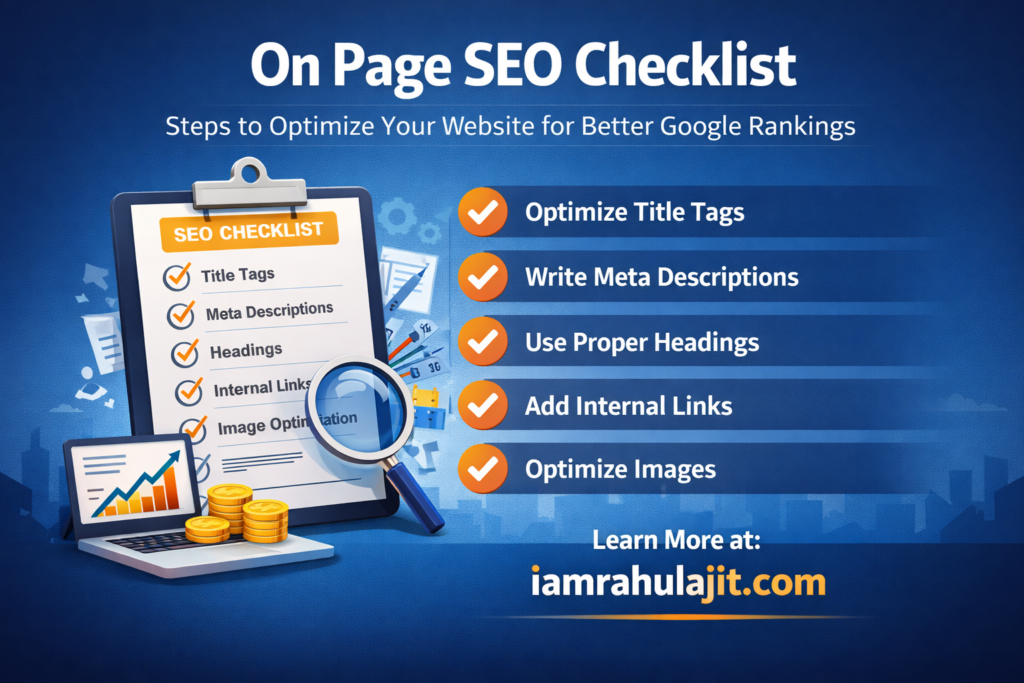
1. Optimise Title Tags
The title tag is one of the most important ranking factors.
Your title should:
- Clearly describe the page content
- Include the target keyword naturally
- Stay within 50–60 characters
- Encourage users to click
A strong title improves both rankings and click-through rates.
2. Write Compelling Meta Descriptions
Although meta descriptions do not directly affect rankings, they influence user behavior.
A well-written description can increase the number of users clicking on your page in search results.
Good meta descriptions should:
- Be under 160 characters
- Clearly explain the page
- Include relevant keywords naturally
3. Use Proper Heading Structure
Headings help organise your content and improve readability.
A well-structured page typically includes:
- H1 for the main title
- H2 for main sections
- H3 for subtopics
This structure helps search engines understand the hierarchy of your content.
4. Optimise Images
Images improve user experience but must be optimized properly.
Best practices include:
- Compressing images for faster loading
- Using descriptive alt text
- Naming files properly
Optimized images improve accessibility and contribute to better SEO.
5. Improve Page Speed
Page speed is an important ranking factor.
Slow websites can frustrate users and increase bounce rates.
Ways to improve page speed include:
- Compressing images
- Reducing unnecessary plugins
- Using caching
- Optimising code
Fast websites provide a better user experience and improve search performance.
6. Use Internal Linking
Internal links connect related pages within your website.
They help:
- Improve navigation
- Distribute page authority
- Help search engines crawl your site
For example, blog posts about SEO can link to related digital marketing resources.
Some of these practical strategies are also discussed in detail on iamrahulajit.com, where I share insights based on real digital marketing experience.
7. Focus on Content Quality
Even with perfect optimisation, content must provide value.
Search engines prioritise pages that:
- Answer user queries clearly
- Provide accurate information
- Offer useful insights
High-quality content improves engagement and increases the likelihood of ranking higher.
On Page SEO Checklist: Conclusion
Implementing a structured On Page SEO Checklist is not just about ticking boxes, it is about building a strong foundation for long-term search visibility. Many website owners focus heavily on backlinks or paid advertising while ignoring the technical and content elements within their own pages. However, on-page optimisation is something you have full control over, and when done correctly, it can significantly improve rankings over time.
Search engines are constantly evolving, but their core objective remains the same: to deliver the most relevant and helpful results to users. This means your website should prioritize clarity, structure, and value. Pages that are easy to navigate, clearly written, and logically organized tend to perform better because they enhance user experience. Following a consistent On Page SEO Checklist ensures that every important optimization element is covered properly.
Another critical factor is consistency. Optimizing one page is not enough. Every important page on your website — including blog posts, service pages, and landing pages — should follow the same structured optimisation process. By applying the same On Page SEO Checklist across multiple pages, you gradually build stronger topical relevance and authority for your website.
It is also important to understand that on-page SEO works best when combined with high-quality content. You can optimize titles, headings, and images perfectly, but if the content does not answer user questions effectively, rankings will be difficult to sustain. Search engines now evaluate user behavior signals such as time on page, bounce rate, and engagement. When users find your content useful, they stay longer, explore more pages, and interact with your website.
Additionally, businesses should regularly audit their existing pages. SEO is not a one-time task. Updating outdated information, improving internal links, refining keyword placement, and enhancing readability can revive older pages and improve their performance. A well-maintained On Page SEO Checklist makes it easier to track these improvements and ensure every page continues to meet modern SEO standards.
From my experience working on website optimisation and digital marketing strategies, businesses that follow a structured optimisation approach often see steady improvements in their search rankings. For more practical SEO insights and digital marketing strategies, you can explore resources available on iamrahulajit.com, where I share actionable guidance based on real-world experience.
In conclusion, using a clear On Page SEO Checklist helps ensure your website remains optimised, user-friendly, and competitive in search engine results.